CEOs today face a new kind of volatility, with shifting trade and tariff policies making strategic leadership critical. Will this turbulence rival the 2008 global financial crisis (GFC) or the 2020 COVID-19 pandemic? Time will tell, but as global trade realigns, leading CEOs are acting decisively, turning uncertainty into opportunity.
Bold CEOs reassess operations, make tough calls, and free up capital for future growth. Inaction isn’t an option. Those who move early to reshape their portfolios could gain a lasting edge.
Our latest EY-Parthenon CEO Outlook Survey, conducted in March and April 2025, brings into focus urgent strategic questions at the top of the boardroom agenda. Select the tiles below to find out more.
This disruption is demanding a rethinking of global relationships – from supply chain strategies to portfolio optimization, cost management to financial resilience. CEOs will need to navigate regional economic shifts with local sensitivity and global awareness. Geopolitical risk management is now a critical pillar of strategic planning, as the world moves toward a more regionalized economy.
CEOs also need to consider how pre-existing pressures, especially around technology; an evolving competitive landscape; a talent squeeze; and shifting customer behaviors are being shaped by the changing global environment.
The most successful CEOs embrace the paradox of uncertainty: planning carefully, acting decisively and shaping their futures with confidence. By balancing agility with discipline, they position their companies to emerge stronger and more resilient.
CEOs now find themselves in an environment where the path forward is difficult to discern. Economic predictions face unprecedented complexity amid escalating trade conflicts. Supply chains built over decades may unravel with alarming speed.
Macroeconomic indicators will become increasingly difficult to interpret accurately. The global economy was not showing signs of strength even before the recent rise in uncertainty. Most forecasts had been revised down since the start of the year. They are likely to be downgraded further.
In a landscape this fluid, clinging to single-point forecasts misses the mark. Business leaders need to embrace a mindset shift: it’s multiple scenarios, not singular predictions. Probability distributions offer a more realistic lens to capture the wide bands of uncertainty. This convergence of structural, political and economic forces is challenging the very foundation of traditional forecasting.
CEOs will also have to cultivate an agile mindset to enhance their financial resilience. While credit lines remain open there has been a tightening of financial markets over the past few months. Similarly, an economic slowdown will stress their ability to generate their own capital for critical investments. To remain as resilient as possible, CEOs need to view cost consciousness not as a sign of failure, but as a fundamental aspect of their strategic focus. In doing so, companies can better position themselves to navigate the complexities of today’s market while continuously adapting to meet future challenges through investing in the capabilities and assets required to accelerate success.
CEOs were already acting to mitigate geopolitical risks prior to recent tariff tensions. The majority (85%) had made alterations to their strategic investment plans over the past 12 months, and over half of those have delayed a planned investment. Nearly 4 in 10 (39%) have relocated operational assets to another geographic market, which is likely to increase in the future as the potential implications of new tariff arrangements are better understood.
Integrating geostrategy into boardroom decisions is critical. CEOs who implement a geostrategy that addresses all the developments of relevance for their company are likely to be better positioned to build a robust strategy that will help navigate an increasingly volatile environment. EY-Parthenon have developed a framework to help CEOs navigate geopolitical challenges and establish their own geostrategy.
While the US tariffs announced on April 2 have been put on hold for 90 days, universal 10% tariffs, along with significantly higher tariffs on China and sector-specific tariffs, remain in place. CEOs are considering what steps they can take to mitigate their impact.
Top 5 actions to mitigate the potential impact of increased tariffs on company’s operations and sales in the next 12 months:
- Exploring domestic sourcing alternatives and rebuilding supply networks locally
- Accelerating innovation in product design and materials to reduce reliance on tariffed materials
- Absorbing the additional costs internally through operational efficiencies and cost reductions
- Diversifying our supply chain by shifting production or sourcing to non-tariffed regions
- Passing the increased costs on to customers through strategic price adjustments
It is clear that CEOs and their executive teams will be using a wide range of options to retain competitive position. The already tightening economic conditions have made passing the increased costs on to customers through strategic price adjustments the least-selected option.
Even without the added pricing pressures of extraordinary tariff levels, CEOs were already concerned about the pressures of inflation on their businesses. More than 7 in 10 agree that inflation continues to be a challenge and will be an issue they need to navigate for the next year.
But there are actions CEOs and their leadership teams can take now to get ahead of any reimposition of tariffs:
1. Establish and map current state:
- Analyze current state supply chain, and overlay with trade parameters, e.g., duty rates and free trade agreements to establish a baseline cost model.
- Perform impact assessment and model potential scenarios.
- Assess different duty rates based on country of origin.
- Conduct risk analysis applicable to specific markets.
2. Build your “tariff team”:
- Align business units (e.g., customs, tax, legal, and risk) to consider the tariff impact across their area of the business.
- Consider phase 1 outputs against business-specific tariffs to understand how, what, when and where tariff exposure will occur.
- Align on roles and responsibilities in mitigation strategies and support for C-suite stakeholders in future phases.
3. Customs mitigation and recovery planning:
- Mitigate increased tariffs and trade exposure through customs process assessments (e.g., origin and valuation planning):
- Can certain elements of the supply chain be moved from impacted markets to confer new origin of finished goods?
- Can the first sale for export rule be applied?
- Can there be closer alignment of transfer pricing and customs value?
- Apply deferral and recovery of import duties paid — foreign trade zone and substitution duty drawback where possible.
4. Supply chain and tax planning:
- Work with your tariff team across the organization to consider effective supply chain restructuring and supplier network optimization.
- Consider alternative sourcing scenarios.
- Assess supply chain, logistics and procurement performance, with an overlay from the current state mapping to evaluate and possibly reorganize trade flows.
These actions require CEOs to work across teams and within silos in their company. While tariff and trade issues can be seen simply as a supply chain issue, they are ultimately a strategic concern that will likely shape the global structure and operations of the company for many years to come.
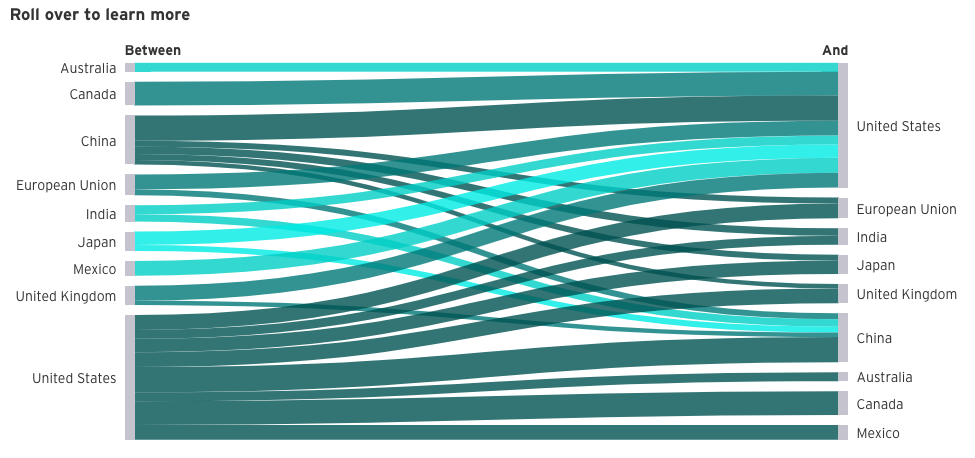
It is not necessarily the most important trading relationship of companies’ headquartered locations, or the most local ones, that are of most concern. While 42% of respondents from China are most concerned about the tariff and trade dispute with the US, 8% are more concerned with the relationship between the US and Mexico. This underscores the deep interconnection of the global economy and the complexity of navigating a tariff war – particularly as other major economic powers respond to potential US tariffs.
Open image description
Rising global trade tensions will also accelerate existing government plans to adopt sovereign industrial policies, with increased strategic state intervention aimed at strengthening industrial security. Successive global crises and increasing geopolitical tensions have exposed vulnerabilities in supply chains, prompting governments across the world to prioritize critical products in key industries.